


Notes d’orientation
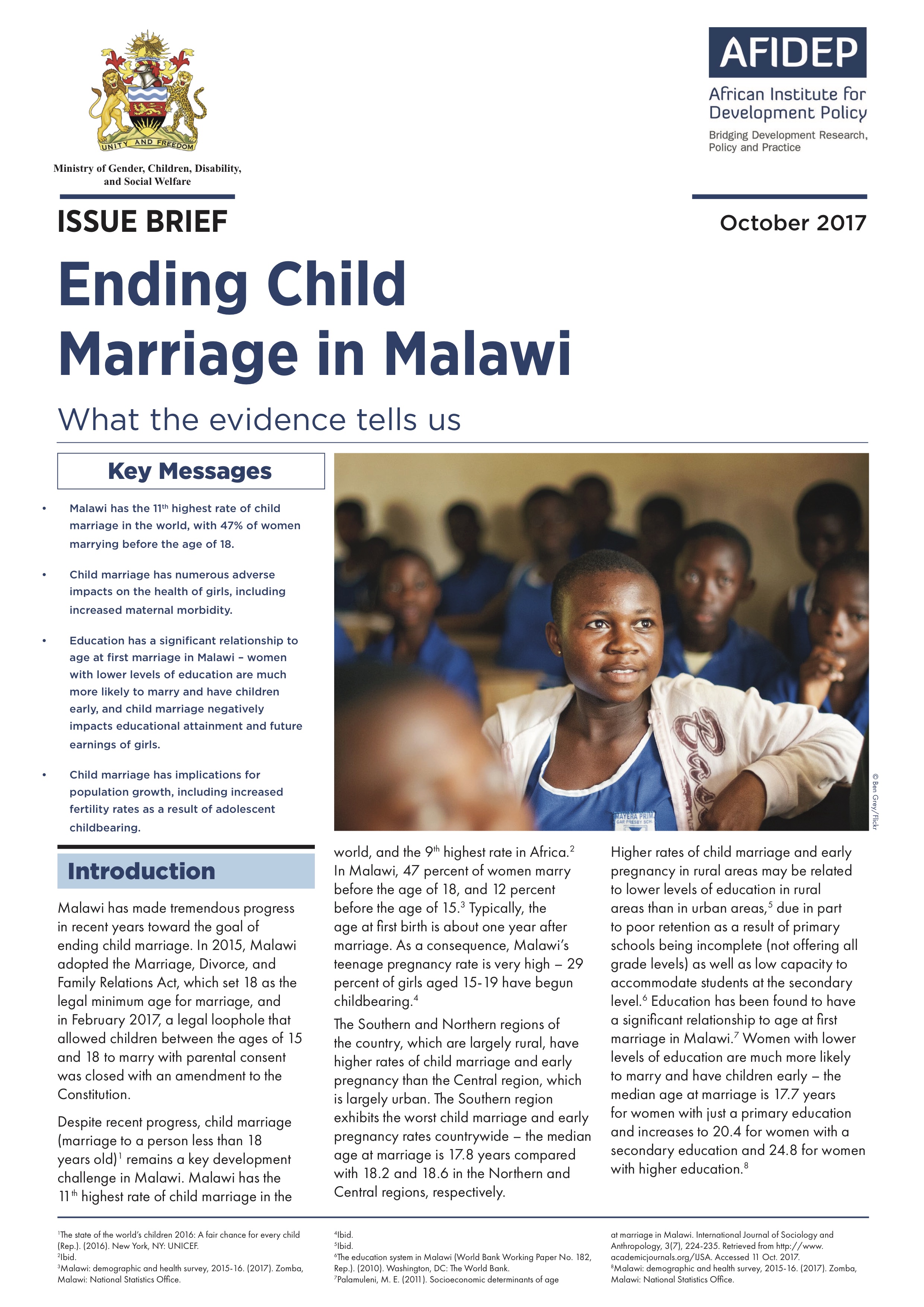
Malawi has made tremendous progress in recent years toward the goal of ending child marriage. In 2015, Malawi adopted the Marriage, Divorce, and Family Relations Act, which set 18 as the legal minimum age for marriage, and in February 2017, a legal loophole allowing children between the ages of 15 and 18 to marry with parental consent was closed with an amendment to the Constitution.
This policy brief highlights the policy and programme options that Rwanda can adopt to enhance human capital development to optimise its chances of harnessing the demographic dividend. It is derived from the Rwanda DD study, which showed that the age structure that would result from a decline in birth rates from the current level of 4.2 births per woman to 2.3 births by 2050 would propel the country to graduate to middle-income status with per capita GDP of US$ 4,014 by 2035 and to high-income status with per capita GDP of US$ 12,555 by 2050.
This brief summarises results of the study carried out to assess the potential demographic dividend (DD) that Rwanda can earn under various policy scenarios and identify the policy actions that the country can invest in to harness the DD. The study involved a review of the country’s demographic and economic policies and programmes, modelling the DD using the DemDiv modelling tool, and interactive discussions with various stakeholders to identify key policy options for harnessing the DD.
This brief is derived from the Rwanda Demographic Dividend (DD) study, which showed that reducing birth rates from 4.2 to 2.3 births per woman by 2050 would produce an age structure with more working age people than dependents. This would propel the country to upper-income status with GDP per capita of US$ 12,555 by 2050.
This brief highlights the key policy and programme options that can help accelerate economic productivity and job creation in Rwanda to enable the country earn the DD. The brief draws on findings of the Rwanda DD study that showed that the country can graduate to middle-income level with per capita GDP of US$ 4,014 by 2035 and to a high-income country with per capita GDP of US$ 12,555 by 2050 if the country adopts an integrated investment model that simultaneously prioritises investments to facilitate voluntary decline in fertility, education, health and job-focused economic reforms.