


Policy Briefs
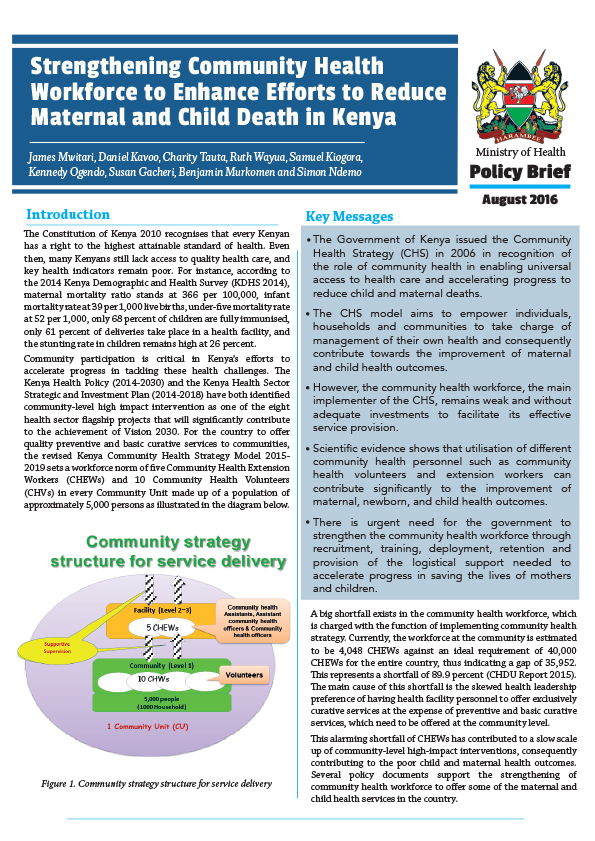
The Constitution of Kenya 2010 recognises that every Kenyan has a right to the highest attainable standard of health. Even then, many Kenyans still lack access to quality health care, and key health indicators remain poor. For instance, according to the 2014 Kenya Demographic and Health Survey (KDHS 2014), maternal mortality ratio stands at 366 per 100,000; infant mortality rate at 39 per 1,000 live births; and under-five mortality rate at 52 per 1,000.
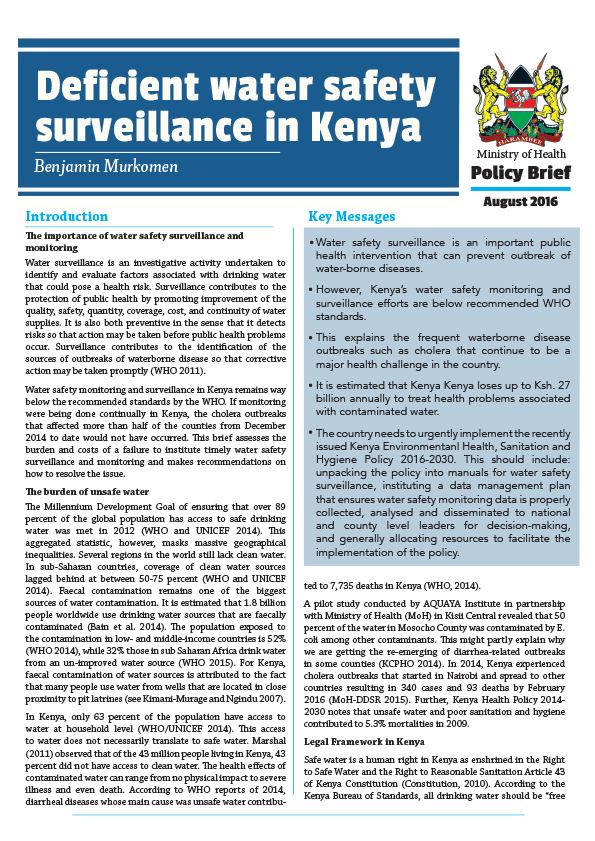
Water surveillance is an investigative activity undertaken to identify and evaluate factors associated with drinking water that could pose a health risk. Surveillance contributes to the protection of public health by promoting improvement of the quality, safety, quantity, coverage, cost, and continuity of water supplies. It is also both preventive in the sense that it detects risks so that action may be taken before public health problems occur.
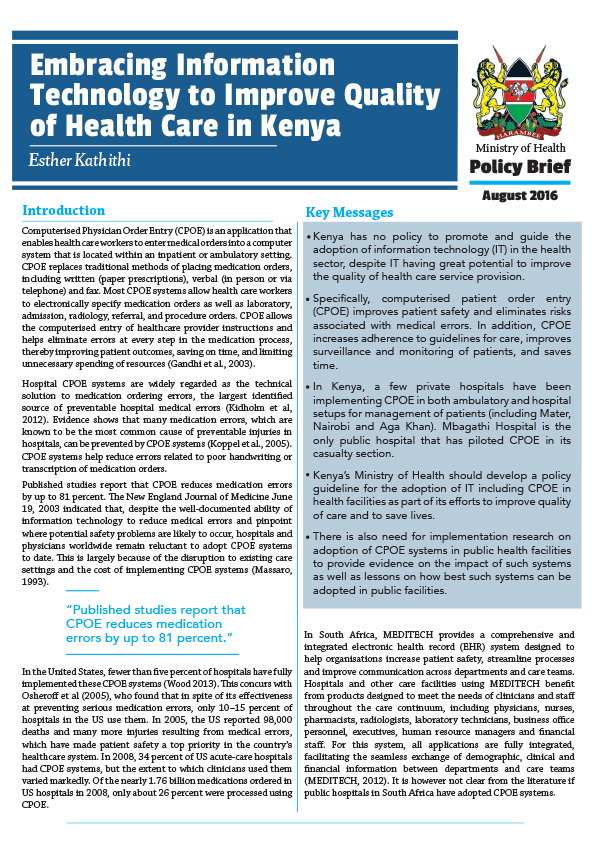
Computerised Physician Order Entry (CPOE) is an application that enables health care workers to enter medical orders into a computer system that is located within an inpatient or ambulatory setting. CPOE replaces traditional methods of placing medication orders, including written (paper prescriptions), verbal (in person or via telephone) and fax. Most CPOE systems allow health care workers to electronically specify medication orders as well as laboratory, admission, radiology, referral, and procedure orders.
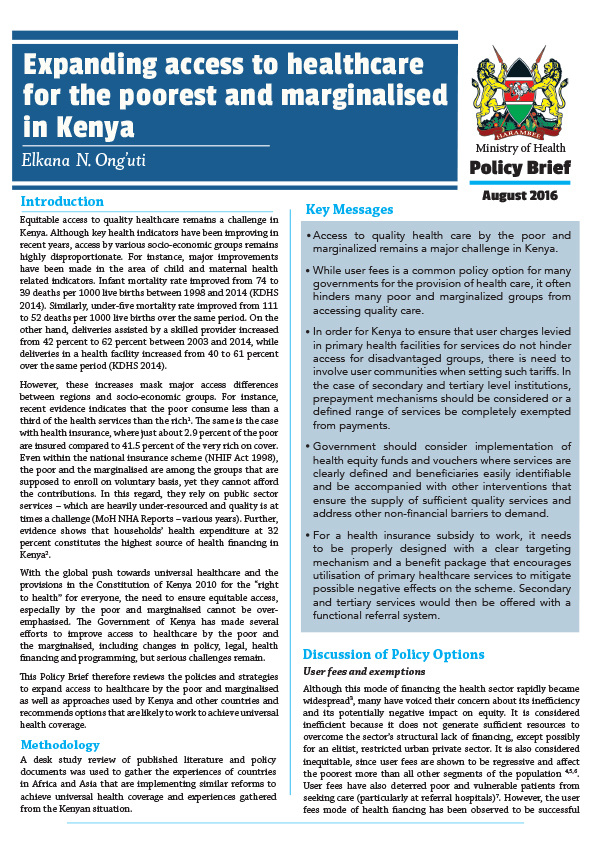
Equitable access to quality healthcare remains a challenge in Kenya. Although key health indicators have been improving in recent years, access by various socio-economic groups remains highly disproportionate. For instance, major improvements have been made in the area of child and maternal health related indicators. Infant mortality rate improved from 74 to 39 deaths per 1000 live births between 1998 and 2014 (KDHS 2014). Similarly, under-five mortality rate improved from 111 to 52 deaths per 1000 live births over the same period.
Non-communicable diseases and conditions (NCDs) include cardiovascular diseases, cancers, diabetes and chronic respiratory diseases. The World Health Organization estimates that NCDs kill 38 million people each year with three quarters of these deaths (28 million) occurring in low and middle-income countries. Globally, 16 million NCD deaths occur before the age of 70, with 82 percent of these “premature” deaths occurring in low- and middle-income countries.
Quality health information providing correct measurements and accountability in the health sector is very crucial for evidence-based decision-making and tracking progress of policy and programme actions. The health sector needs quality information primarily for performance, financial and political accountabilities required to implement the Vision 2030 goals as well as the mandates provided for in the Constitution. The sector requires critical information for efficient resource investments in these important areas to optimise provision of quality healthcare to the citizens.
Global studies suggest that one in every two children aged 5-9 years old have at least one tooth cavity, and the proportion increases to eight in every ten children 12-17 years old. This finding concurs with studies done in Malawi. In Blantyre, 34 percent and 95 percent of children aged 12-15 years old had caries and bleeding gums, respectively. Another study conducted in Mchinji, Ntchisi and Nkhotakota among school-going children showed that 54 percent had caries and 65 percent had bleeding gums. Poor access to care due to lack of highly trained dental health workforce in the country is also […]
Cervical cancer is a major public health problem that kills approximately 250,000 women globally every year. It especially affects women in low-income countries. Low-income countries accounted for 370 000 out of a total of 466 000 cases that were estimated to occur in the world in 2000. It is the third most common cancer worldwide and the leading cause of cancer death among women. Malawi has the highest rate of cervical cancer worldwide, estimated at 75.9 per 100,000 population. It is the second common cancer overall (25.4 percent) of all cancers in the country and the most common (45.4 percent) […]
The vision of the Malawi Ministry of Health (MoH) is to achieve access to health for all the people of Malawi that would enable them to live a quality and productive life. One of the strategies to achieve this is the identification of a prioritised list of health interventions provided free of charge to the population – “the essential health package”. However, available resources are not adequate to cover the cost of delivering the essential health package. In 2014-15 financial year, for example, the cost of funding health care provision was approximately two times higher than the available resources. This […]
Access to antiretroviral therapy (ART) for children under 12 months in resource-limited countries is constrained by the unavailability of HIV-diagnostic devices that can perform DNA/Polymerase Chain Reaction (PCR) HIV tests at service delivery points. The Early Infant Diagnosis (EID) platforms in current use in Malawi have been found to be too complex to be placed at district level and do not qualify as a point-of-care test method.
The sustainability of any gains made by research activities hitherto led by international research organisations requires the effective transfer of knowledge and skills to local research collaborators or partners. However, the state of affairs in many international health research projects in Malawi does not reflect this vision. Local researchers have little or no knowledge of how study samples are managed, i.e. how the samples are analysed, which tests are used, who really owns the samples and when the samples will be destroyed, among other considerations.

Drug pilferage has been considered as one of the contributing factors for shortage of drugs not only in Malawi, but also in other African countries. A report from the United States President’s Malaria Initiative (PMI) highlighted some of the ways through which malaria drugs are trans-continentally diverted in Africa to include illegal diversions that would occur when a genuine pharmaceutical commodity approved and intended to be used in a specific country is illegally intercepted and sold in another country.